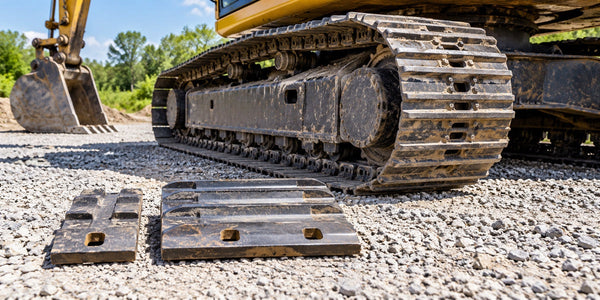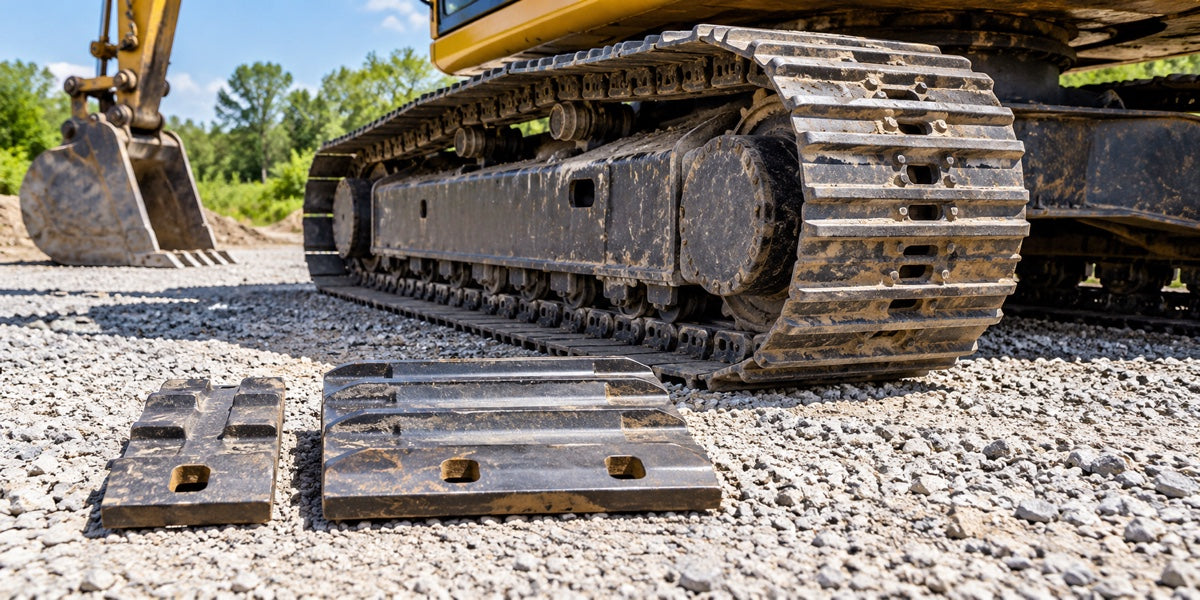
Track Shoe Width: Match the Ground and Undercarriage
Wider track shoes are not automatically better. Width affects how the machine’s weight is carried on the ground, while the selected shoe must also match the undercarriage and the work the machine is expected to perform. The correct choice comes from the machine configuration and its manufacturer’s guidance, not a broad rule that every soft surface needs the widest shoe.
Balance flotation with undercarriage load
Komatsu’s undercarriage guidance advises using the narrowest shoe width that still provides and maintains adequate flotation. It notes that an unnecessarily wide shoe can increase loading on shoes and hardware, while extra width does not by itself create greater penetration into the ground. That guidance explains the trade-off; it is not a substitute for the specification of a particular excavator.
Start with the work conditions: firm or yielding ground, expected travel, turning frequency and the support needed to avoid excessive sinking. Then consult the operator’s manual and parts catalog for the approved shoe type and width for the machine’s model and serial range. Keep the operating requirement and the parts fitment check separate.
Confirm the shoe-to-chain interface
Before ordering, compare the catalog part number and configuration with the installed undercarriage. Verify the shoe width, plate style, bolt-hole spacing and count, bolt specification, and the track-chain family using the correct drawing or physical measurement. Also check whether the machine has a standard or special undercarriage configuration. A match in overall width does not prove the bolt pattern or chain interface is correct.
Record the full model suffix and serial number. If the machine has been converted or rebuilt, identify the undercarriage actually installed rather than relying only on the original machine model. Photograph the shoe and its mounting face and compare them with the parts illustration.
Use a simple decision sequence
- Find the machine’s approved shoe options in its manual or parts catalog.
- Choose the narrowest approved option that meets the site’s flotation requirement.
- Confirm the exact shoe-to-chain and fastener interfaces from the parts drawing.
- Check the selected shoe type against the expected ground and operating pattern.
The KuduParts listing for track shoe 201-32-71310 names a range of Komatsu models but does not provide shoe width, hole spacing or fastener dimensions. Confirm the exact serial-specific catalog match before ordering; do not infer those measurements from the product title or from another manufacturer’s shoe.
Keep wear checks in the plan
After installation, inspect for loose or missing hardware and follow the equipment manual’s undercarriage inspection and track-tension procedures. Komatsu recommends routine inspection for uneven or excessive wear and damaged or missing components. Record the shoe type and width installed so later wear observations can be compared against the actual configuration.
Practical takeaway: site conditions guide the flotation requirement, but the machine’s approved parts data determines which shoes fit. Select for both, and document the evidence.